
Meet Jo Hensel: from French horn player, to Coaching Psychologist
In the Spotlight: Jo Hensel
At Guildhall Ignite we have over 40 brilliant coaches with different specialisms, who deliver a range of programmes and workshops to managers and leaders across the creative industries, education, business and more.
Discover more about coaching from Guildhall Ignite
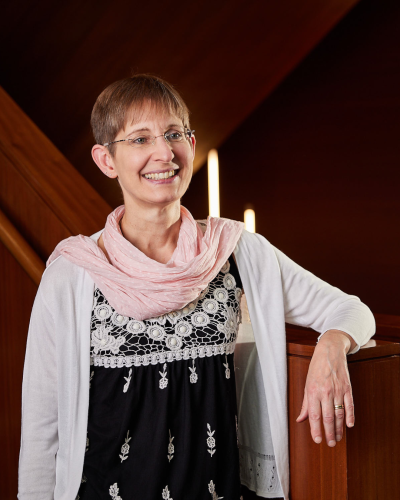
Today we're delighted to introduce you to Coaching Psychologist, Jo Hensel who tells us the story of how she became a Coaching Psychologist via the route of studying French horn at Guildhall School.
Growing up in a medical household
At the age of 13, if someone asked me what I wanted to be when I grew up, I’d reply “a psychologist.” Both my parents were doctors. My Dad was a GP in a semi-rural practice and along with many doctors of that time, he placed a great deal of emphasis on diagnosing illness and prescribing the appropriate medical treatment. He would delight in coming home with freebies from the medical reps, each of whom was promoting some sort of magic cure or another. I remember the alarm clock that played the first few phrases of Mozart’s Symphony No.40 on repeat and the pads of drawing paper with the names of drugs inscribed on every page. By the age of 10, I was familiar with the names of a wide range of drugs and the 'cures' they could effect. What fascinated me more though, were the stories of troubling patients whose diagnoses remained elusive and any treatment, therefore, ineffective.
Curiosity about the mind-body connection
There was the patient who would regularly get Dad out of bed at 2am on a Thursday (Dad’s on duty night) to treat his pain with a strong pain killer that could only be administered by a medical professional. Despite numerous hospital tests, the cause of the pain remained elusive. Dad would shrug his shoulders in exasperation, saying “It’s all in his head".
There was the young mum who refused to eat, becoming dangerously underweight. I overheard Dad discussing the distressing case with Mum, “I’ve told her that if she doesn’t eat, she’ll die, but she doesn’t seem to take any notice of that even though she’s obviously intelligent”. If my siblings or I complained of a stomach-ache, the treatment prescribed was always a glass of milk to settle our stomachs. No-one thought to ask us what else was going on, or whether we were worried about anything. My parents were both loved and respected doctors in the local community, but the medical model was king, while the shadowy idea of a mind-body connection in illness was rarely, if ever, taken seriously. From a young age, I can remember being curious - and sceptical - about this and wanting to find out more about how the mind and the brain worked and interacted with the body.
Difficult career decisions
As I reached the end of my time at school, I was faced with a challenging decision. I had fallen in love with music and couldn’t decide whether to pursue my study of the French horn at a conservatoire or apply to university to study psychology. I decided that studying music and becoming a professional performer couldn’t wait, whereas I knew that I could always study psychology later down the line. That’s exactly what I did.
Following three years as a music student at Guildhall, I pursued a fulfilling career as a French horn player, performing, touring and recording with orchestras and ensembles in the UK and Europe. While doing this, I completed a psychology degree with the Open University (OU). This was in the 90s, so I had to remember to set my video recorder to record the OU programmes that formed part of the course and were broadcast by the BBC in the early hours of the morning.
On a quest to support health and happiness
Although excellent, with some inspiring tutors, my OU course was written before Martin Seligman became president of the American Psychological Association in 1998 and introduced the concept of positive psychology. It was therefore largely based on a deficit model of the human condition. I can remember feeling particularly despondent in the year that I undertook the social psychology module. I had hoped to find some answers to how psychology could support people to become healthier, happier and to live together more harmoniously, but instead I was reading about the powerful role of genetics and lifelong social conditioning in adverse human behaviour.
Satisfied that I had chosen the right primary career path, I continued to perform, including as a member of the Academy of St Martin in the Fields, an orchestra that I joined in 1998 and remain an active member of to this day. In many ways, it feels like my second family. I also seized every opportunity to support others’ learning in a variety of different settings. These included teaching young people in schools and other youth music settings, developing and delivering music-based workshops in the corporate space, supporting instrumental and song-writing workshops in prisons, homelessness centres and other community settings and working with young people at the beginning of their professional careers. I also spent four rewarding years as a school Director of Music, my first foray into line management, leaving this role in 2011 to become Deputy Head of Wind, Brass and Percussion (WBP) at Guildhall. The timing could not have been better.
Discovering coaching
In 2012, Guildhall began to offer coach training to members of staff, with a view to engendering more of a coaching culture in the organisation. I was curious to see how this training might support my work with the many students and staff in the WBP department and beyond. To this day, I see my participation in the five-day intensive training with Jane Cook and Jenny Rogers, as a pivotal point in my life. As I wrote in my feedback following the course “I will never see the world in the same way again.” The coaching skills gave me the language and the practical tools to support people to become healthier, more fulfilled and to navigate relationships more successfully. These were all the things I had been looking for, but had not found, in my psychology degree.
I went on to undertake the Advanced course, which qualified me for the EMCC Practitioner accreditation. Then followed ongoing training in coaching psychology, including in Cognitive Behavioural Coaching, Rational Emotive Behavioural Coaching and even a PhD in Coaching Psychology (thesis submitted, now waiting for my viva examination at the time of writing). Through the British Psychological Society’s Coaching Psychology pathway, I became a Chartered Psychologist in 2025.
Training others to coach
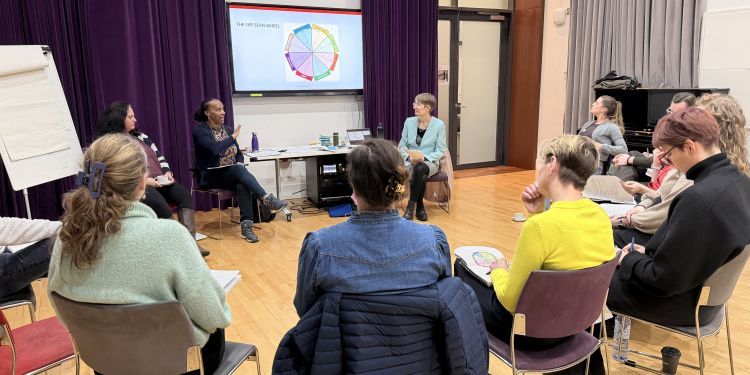
In 2018, I started to support coach training at Guildhall. As a coach trainer, I enjoy working with new coaches to support them to coach cleanly, using a clear framework that supports clients to do their best thinking, leading to those magical 'lightbulb moments'. An experienced coach can make coaching look easy, but in reality, there is both an art and a science to it. Almost invariably, the people who sign up for coach training with Guildhall Ignite are both experts in their own fields and very keen to support others. Perhaps it’s not surprising that as trainers, the first thing we support is some un-learning of the need to have the answers; of the propensity to do the work for the client; of a reluctance to challenge assumptions - both the coach’s own and the client’s. I love going on that journey with coaches-in-training, celebrating the wins and supporting insight when things haven’t quite gone according to plan.
Working with clients under pressure
As a Coaching Psychologist, I specialise in working with the performance confidence and wellbeing of individuals and teams working in high pressure environments. Much of my work is with elite performers, including musicians, actors and dancers, at all stages of their careers from early-career to established professionals.
Through Guildhall Ignite, I also work with leaders, particularly those who find themselves in leadership positions in higher education settings. It’s not uncommon that well respected academics transition from being primarily 'at the coal face' where they are researching and teaching, into more senior leadership roles, often without much training or even appetite for the line management aspect of the role. That’s where coaching can come into its own, supporting individuals to lead more effectively in a way that aligns with their values. I also train on Guildhall Ignite’s Leader as Coach and Manager as Coach courses. Equipping leaders and managers with the self-awareness, skills and tools that come with coach training and hearing how empowering they find their new coaching toolkit as they return to the workplace, is immensely rewarding.
Learning by doing
That’s exactly what we’re always encouraging people to do in coach training. When introducing a new skill or tool, we share the theory, give a brief demonstration and then encourage participants to give it a go for themselves and see how it feels. In the process, we contract for a psychologically safe space, where people can try things out and take risks without fear of failure or being shamed.
We ask for 100 hours of coaching practice on the Executive Coaching - Advanced Level course, and this gives coaches a fantastic foundation from which to continue to learn and grow. Just like learning a musical instrument, becoming an expert coach is a lifelong journey. At Ignite, in order to support that journey, we offer group and one-to-one supervision for all coaches, from those at the very start of their journeys, to those who have been coaching for decades. My approach to supervision, whilst evidence-based, is always flexible, coach-centred and improvisatory even.
When I discovered coaching in 2012, it felt like the missing link. I had spent years performing and teaching and had just moved into a leadership role at Guildhall. The training connected my early interest in psychology with the work I was doing every day and gave me practical ways to support students and colleagues alike. In my role at Guildhall Ignite, I love seeing coaches-in-training discover that coaching can be a missing link for them too, a way to bring their experience and their wish to support others together in a new and potent way.

