In Conversation with CJ Brooke: From Guildhall Young Artist to BMus Composition Student
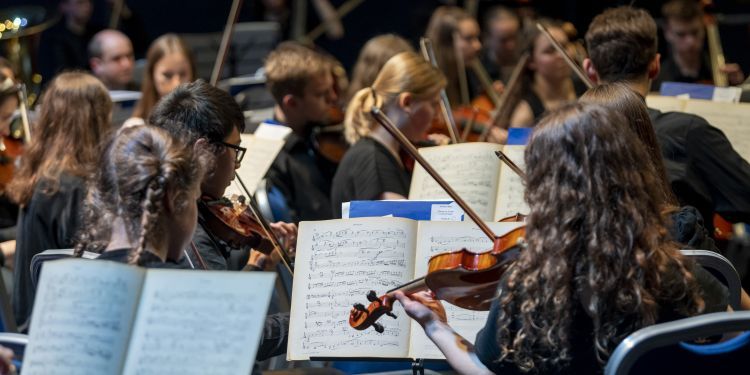
In conversation with CJ Brooke, Guildhall Young Artists Norwich alumni
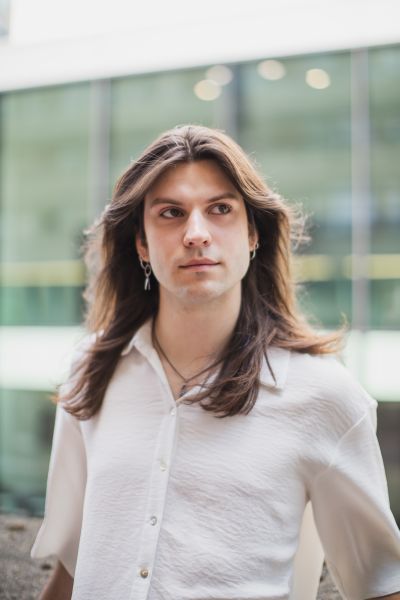
Can you introduce yourself?
My name is CJ Brooke and I am a composer, performer, and field-recordist from Norwich. I am 22 years old and in my third year of undergraduate study in music, with a principal study in composition (with Dr Amber Priestley and Paul Whitmarsh), alongside second studies in sonic arts (with Emily Peasgood) and bassoon (with Helen Storey).
When did you attend GYA?
I was a student at GYA Norwich from 2016-23, so from ages 12-19.
Which courses did you participate in?
Everything I could! Having attended GYA Norwich for the entirety of my teenage years, my interests changed and shifted throughout my time there. As a result, I participated in a huge variety of classes, which included large wind ensembles, wind quintets, clarinet choir, orchestra, jazz bands and improvisation groups, alongside lessons in composition, clarinet and jazz piano.
What did you enjoy the most?
It’s very hard to choose a favourite, having attended such a breadth of classes, but I think my lessons in composition and clarinet stand out as what I perhaps stayed most passionate about throughout my time at GYA Norwich.
Did being part of GYA Norwich open any opportunities for you?
I was lucky to have many opportunities open up for me during my time at GYA Norwich, perhaps one of the most memorable being conducting a fanfare that I was commissioned to write celebrating the renaming of GYA Norwich in a concert at St. Andrews Hall in March 2022, which was performed by both students and staff.
I also had my first commission and experience of a professional ensemble playing my music when I wrote a piece for the Amatis Tri to perform at the Kings Lynn Festival in 2018, which was both incredibly exciting and an amazing privilege at such a young age.
Aside from compositional opportunities, there was just an enormous wealth of opportunities to perform in all kinds of different settings and ensembles, which I think was exceptionally valuable to experience, and formative in my musical journey.
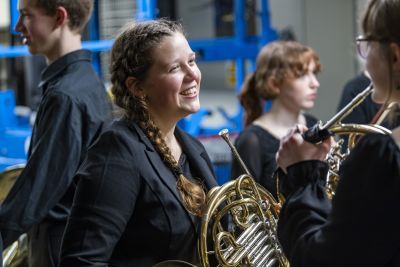
You also attended the Norfolk County Youth Orchestra (NCYO), which is run by GYA Norwich. Can you talk a bit about your experience of this?
I attended NCYO from the ages of 14 to 19 and massively enjoyed my time there. Being a part of the orchestra gave me everything from performance experience and leadership opportunities to friendships, and a great sense of community.

While you were in your second year of the BMus (Hons) programme, you were asked to compose a piece for the London Schools Symphony Orchestra (LSSO). How did this feel?
Coming back to a youth orchestra environment for my commission for the London Schools Symphony Orchestra was an incredibly fulfilling and inspiring experience. I was delighted to have the opportunity to work with a younger generation of musicians and was particularly keen not to leave behind anything that I’d learned from my time at Guildhall School. I didn’t want to write a ‘youth orchestra piece’.
I took a risk in writing quite an experimental and adventurous piece of music - directly transcribing field recordings I took in a park in East London for orchestra - and was blown away by the young musicians’ level of engagement with my ideas and willingness to experiment with their instruments in response to the sounds of the park. I’ve been so endlessly inspired by the world of contemporary music since coming to Guildhall, a world that I had such little contact with beforehand, so I’m glad to have been able to bring some aspects of this into my commission.
What has your experience been like so far attending Guildhall School as an undergraduate?
My experience so far of Guildhall School has been brilliant. I think a large part of what makes it such a special place is the incredible sense of community. Everyone is out there to support each other and lift each other up and most of all, have fun making music with each other.
The composition degree is rigorous and intense, but so rewarding at the same time. I really feel as though I’ve been rebuilt as a composer from the ground up and have found new passions and interests as a result. Being allowed to continue my studies as a bassoonist is also an incredible privilege – I think it’s super valuable to maintain a practice as a performer while studying composition.
What was the audition process like?
For my audition there were two stages. Firstly, I submitted a folio of compositions, which then resulted in a short test paper and an interview. My interview at Guildhall was by far the most enjoyable of any of the interviews I had during my applications. There was a friendly atmosphere, and it really felt as though the panel were on my side and genuinely interested in what I had to say, and the work that I had submitted in my folio and paper.
Is there a project, collaboration, or performance from your undergraduate years that stand out as particularly memorable?
Aside from my project with LSSO, which has likely been the highlight of my studies so far, I’m particularly proud of a piece I wrote in first year called In the round. The piece features a 20m long circular score that is wrapped around the audience, with the performers walking around the outside. The score features a variety of notational approaches, from text instructions and sweeping graphic gestures, to transcriptions of birdsong and folk tunes from around East Anglia.
Some more recent highlights include performing in The Rite of Spring on bassoon with the Guildhall Symphony Orchestra and being the lead curator of the New Music Society’s recent concert LA LA LA: new music for untrained voices in December 2025, a concert of 12 new works by members of the composition community for ramshackle choir!
I’m currently working on my dissertation, which is titled Cultivating nature connectedness through sound and looks at a piece called Listen to the voices of the fen by Kathy Hinde, and I am writing a piece for large ensemble and narrator exploring the folklore and ghost stories of Norfolk’s fenland.
Are there any skills or values from your youth training that still guide your work today?
While my compositional style and priorities have completely changed, I think there are plenty of things that have stuck with me. I really try to maintain a sense of curiosity and play in my practice – a willingness to experiment and try something new and challenge myself instead of getting too complacent or comfortable. Don’t get me wrong, this often results in things not going quite to plan! But these projects that haven’t quite worked out have often led to the most valuable learning experiences, and the pieces that I’m most proud of always follow.
On top of this, the amount of time I spent in ensembles as a young musician was instrumental in developing my people skills and heavily informs my practice today. I like to work collaboratively with performers, and I often find my ideas are deeply rooted in their experience of the work, whether it be in solo or large ensemble contexts. I think music making (and art making in general) has a unique capacity to help us reconsider and explore our relationships with each other as people, and I think the social practice of playing in ensembles as a young musician was foundational to this belief.
Finally, do you have any advice for children and young people that might want to take their passion for music a step further?
I think my main piece of advice is to be curious and explorative, in both your music making and your listening. To me, making things is one of the most important things we can do. I think regardless of whether it becomes your career, everyone should be making things, and especially with other people. Enjoy the act of making and exploring new things; try to learn from the process of making, and don’t be too quick to judge what comes out of it. I think a lot can be gained sticking with something and seeing what happens, instead of labelling it as ‘good’ or ‘bad’ too quickly.
Find out more about Guildhall Young Artists, Guildhall School's network of centres that provides inspiring performing and production arts training for children and young people.
Find out more about Guildhall School's Bachelor of Music with Honours programme.