Conducting & Ensemble Direction
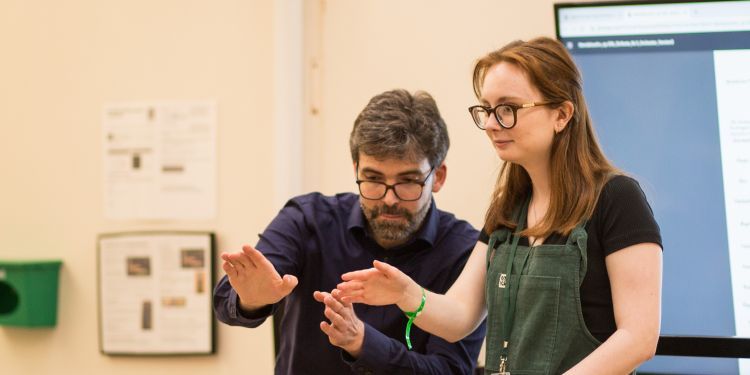
This four-day course will give you a thorough grounding in the physical technique of conducting and will see you conduct a variety of repertoire.
Key information:
- Course dates:
- Tue 14 – Fri 17 Jul 2026
- Course times:
- 10.30am–5.30pm
- Age:
- 18+
- Art form:
- Music
- Fees:
- £515
- Deadline:
- Bookings close at 5pm on Friday, 3 July 2026, or when the course reaches full capacity
- Level of study:
- Short Courses & Summer Schools (ages 18+)
- Mode of study:
- In-person
- Venue:
- Guildhall School of Music & Drama
- When:
- Summer Schools (July–August)
Course info
This course has now ended. Join our mailing list to hear about future dates and new courses or please contact shortcourses@gsmd.ac.uk if you have any questions.
- View our terms and conditions
Ages 18+
Course Dates & Times
Tuesday 14 – Friday 17 July 2026
10.30am–5.30pm
About Conducting & Ensemble Direction
This four-day course will give you a thorough grounding in the physical technique of conducting and you will conduct a variety of repertoire.
Whilst the focus of the course will be on the practical application of conducting technique, you will also receive training in ensemble direction, including score preparation, rehearsal technique and effective verbal communication.
Who is the course for?
- Music educators, professional musicians, and music students with or without conducting experience
- Music educators may be, for example, classroom teachers, peripatetic instrumental / singing teachers, or music service teachers. Professional musicians may already conduct ensembles or be interested in exploring conducting in their career in the future
What can I expect?
You will leave the course with the ability to direct ensembles confidently. Participants will develop a thorough understanding of the physical, technical skills of conducting. In addition, participants will be able to lead rehearsals efficiently and effectively by exploring best practices in - for example - score preparation, rehearsal planning, and verbal communication.
You can expect to conduct a variety of repertoire, initially with two pianists and later with a chamber ensemble. These sessions will be filmed, and copies of the video will be distributed to all participants. Following the course, participants are encouraged to record themselves conducting their own ensemble, in order to receive post-course feedback from the tutor.
Do I need anything for the course?
Prior to the beginning of the course, you will be encouraged to study the music that will be covered during the course. A digital copy of the sheet music to be studied will be provided in advance of the course. At the beginning of the course you will be provided with a course booklet which will contain all the music to be used in the course.
You do not need to own a conducting baton to attend the course.
Course fee
£515
This course has now ended. Join our mailing list to hear about future dates and new courses or please contact shortcourses@gsmd.ac.uk if you have any questions.
- View our terms and conditions
Eligibility
- We welcome participants from all ages 18 and over
- Participants must have sufficient English language skills in order to fully engage with the course
About the Course Tutor
The course is taught by Scott Wilson.
Scott Wilson, London-based Australian conductor, is Head of Orchestra Learning for the Orchestra of the Americas' OAcademy, Director of the OAcademy's Conducting Fellowship, and is a conducting teacher on short courses at Guildhall School of Music & Drama. In addition to teaching students world-wide, through his online studio, he has taught at the Royal College of Music, Trinity College of Music Junior Department, and the Aldeburgh Young Musicians Programme. Also he has worked as an Associate Conductor of the National Youth Orchestra of Great Britain.
His work as an educator is underpinned by the manual on conducting technique. In addition, he has written a book on audience engagement and development for orchestras - You ain’t heard nothin’ yet: The Potential of Orchestral Music. During the pandemic this was developed into the podcast A Thousand Pictures.
Previously he was Zander Fellow with the Boston Philharmonic Orchestra, Artist in Residence and Conducting Fellow at Guildhall School of Music & Drama. His musicianship is founded on the pedagogical traditions of Ilya Musin and Nadia Boulanger, which he received under the mentorship of his principal teachers Sian Edwards and Norman Beedie. He studied with Kurt Masur in Sweden, Gianluigi Gelmetti in Italy, Johannes Fritzsch in Australia, and Ed Spanjaard in Hungary. Recently he made his debut at Opera Holland Park, conducting Mark Adamo’s Little Women.
In his former career as a percussionist, he specialised in contemporary solo and chamber repertoire. He worked with the Australian World Orchestra, Birmingham Contemporary Music Group, Philharmonia Orchestra, Royal Shakespeare Company, and at the Royal National Theatre, recorded chamber music for the BBC, and performed at contemporary music festivals throughout Europe.


Find the Short Course that's perfect for you
Explore our Short Courses & Summer Schools