
Discover Junior Guildhall: applications now open

What makes Junior Guildhall a special place to study?
Junior Guildhall offers advanced training across music and drama to young people aged 4 to 18. Students often continue their studies at university, eventually making careers in the profession, while others explore completely different fields, benefiting from the wide range of transferable skills that come from learning with Junior Guildhall. We asked a young actor and two teenage string players to share their experience of Junior Guildhall.
Applications have just opened, apply by 1 March 2026, auditions take place between mid-March and April 2026 for enrolment in September 2026. Apply now!
Dora is a violinist and has been part of Junior Guildhall since 2022. A typical Saturday includes her violin lesson followed by chamber choir, string ensemble, theory class, symphony orchestra and chamber music. She was drawn to study at Junior Guildhall in part because of its family-like environment which ‘allows people to grow as musicians without an overly competitive feeling.’
Kate is a drama student and entering her fourth year at Junior Guildhall, where she takes the Advanced Acting class which prepares students in Years 11, 12 and 13 for auditions to higher education drama departments. Coming from a small village in Wiltshire, Kate says that being able to attend Guildhall at the weekends has been life-changing, allowing her to collaborate with like-minded people.
Eduard has been at Junior Guildhall since 2023 and takes classes in composition and conducting alongside his principal study of the double bass. He is especially appreciative of his double bass tutor, Liz, noting how ‘she always ensures I’m prepared musically and mentally, especially when it comes to potentially stressful auditions and recitals.’
We discussed what makes Junior Guildhall special for them.
What’s your favourite thing about Junior Guildhall?
Eduard: Being able to be part of such a unique, inspiring community of young talented musicians. Every Saturday, I take part in creating and performing high-standard orchestral repertoire which at first may seem challenging, but in the end is always rewarding.
Dora: The kaleidoscope of opportunities available for students – there are a wide range of classes available from conducting to electronic music. I’m also so grateful for my amazing teacher Ruth Hahn, who has not only massively improved my technique but also my musical insight.
Kate: I am constantly learning about the craft of acting, looking at plays that span the ages. Our wonderful teacher Alasdair Middleton has completely transformed the way I approach acting – I’m always challenged and encouraged to improve and produce work that I’m proud of.
What’s the most important thing that you’ve learned?
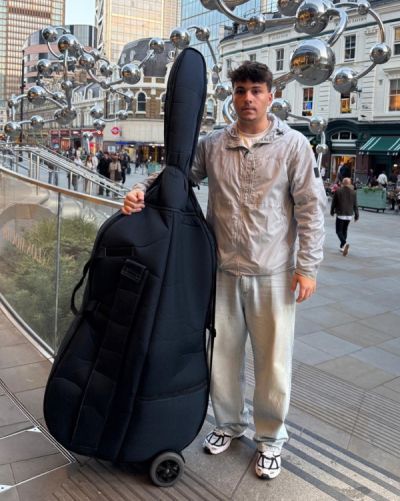
Eduard: I’ve learnt just how special music is to so many young people and how it positively impacts our lives.
Dora: Above all, I’ve learnt that violin playing is a social experience. We spend hours practising by ourselves so we can bring our skill to a group setting. Only in very specific repertoire are we playing alone and even then, performing to an audience involves social interplay.
Kate: Over the years, I’ve been exposed to a variety of different plays from different writers and encouraged to explore characters in a way I’ve never done before, looking deeply at their motivations, intentions and barriers.
What would you say to someone who is considering applying?
Eduard: if you have a strong love for music, whether jazz or classical and are willing to take on a musical life or even career, joining Junior Guildhall will ensure the best outcome for you.
Kate: I’d say go for it! Attending Junior Guildhall has been such an enriching and valuable experience, expanding my skills as an actor and ability to interpret text.

Dora: Junior Guildhall is such a good preparatory school for higher education. Even if you’re not aiming for a career in the performing arts, the deep skills obtained here will be of value in multiple life contexts.
And finally, give us your top tips for auditions
Dora: Have confidence in yourself! Whether or not the end result is what you wanted, the process of applying will develop your playing. And remind yourself that you’re applying to a school – the panel are looking for potential rather than a fully-formed musician.
Eduard: My top tip would be to not only choose pieces which are technically challenging, but ones where you can show who you are as a musician and just how much you enjoy playing them.
Kate: Be yourself and try to relax. Choose a speech that you enjoy that will shine through in your audition. But most of all, enjoy the experience!
Applications for Junior Guildhall open on 7 January 2026 for entry in September 2026.
Applications for Junior Guildhall are now open
Apply now

