In conversation with BA Production Arts (Stage Management) second year students Summer Minnott and Charlie Tiernan

In conversation with BA Production Arts (Stage Management) second year students Summer Minnott and Charlie Tiernan who have recently completed their allocations on Guildhall Opera productions.
We sat down with Summer and Charlie to hear about their journeys in the BA Production Arts programme through the Stage Management pathway.
They talk about their recent roles in various Opera productions, what initially drew them to study in London and what they have learned from working within Guildhall’s thriving performance environment.
Why did you choose to study at Guildhall School, and what drew you to Stage Management?
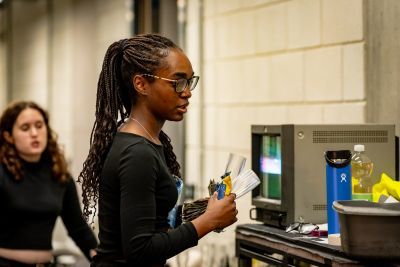
Summer – My first introduction to Guildhall was through Get Backstage, which was a week-long course highlighting what Production Arts has to offer. Through this scheme, we took part in a cueing exercise using the prompt desk, comms, and cue lights. I knew Stage Management was something I wanted to pursue further.
Despite growing up in London, after looking into Guildhall and having a big desire to study here, I chose to stay. London has such a range of theatrical events to offer, and staying would give me so much more opportunity to immerse myself in a profession I love.
Charlie – Guildhall drew me in due to its large plethora of alumni that are working in the industry. Lots of people I had met or shadowed prior to applying were graduates of the school and spoke very highly of their experience. Knowing it produced such high-level professionals, Guildhall was immediately on my radar.
With not being from London, I always associated the city with the West End and theatre scene in general, therefore it was natural of me to want to study a place that thrives on creating art. Stage Management was such a great course to follow as it opens the door to so many roles after graduation, also, studying it at Guildhall means you still have the chance to explore aspects of other Production Arts Pathways through associated studies.
How did your recent production roles come about, and what support did Guildhall give you during the process?
Summer – At the end of the first year Helen had a conversation with me about how I would feel about Stage Managing one of the Autumn Opera Scenes productions. At first, I was slightly nervous to work on a Postgraduate Opera performance as a second-year student, but the support from Guildhall staff made it easier. Guildhall has a firm foundation in peer learning, and the Production Arts department really feels like a community. Observing my peers and getting advice from the graduating cohort was beneficial in gaining a deeper understanding of the job role and expectations.
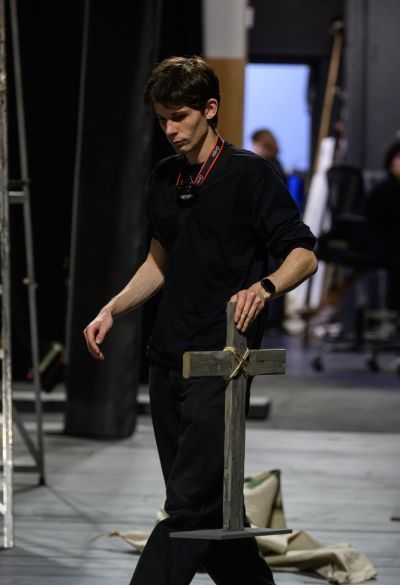
Charlie – I have always had an interest in Opera, and I am keen to be able to build my skills in cueing for music scores and large scale shows with many elements like lighting, sound, automation etc. Expressing this interest during my first year led me to get the role of Assistant Stage Manager on the recent opera double bill - Der Wald/Lucrezia.
Guildhall’s supervision during productions is as hands-on as you need. Tutors are always available for advice, but you’re encouraged to work independently. Tutorials and meetings formally track progress, and peers are incredibly supportive throughout.
Looking ahead, I am excited to work on more shows in different roles. In the Spring I will be a costume assistant in a drama production and Deputy Stage Manager on a smaller opera. I really enjoy working with different teams, including professional guest directors and designers.
What did an average rehearsal or tech day look like for you?
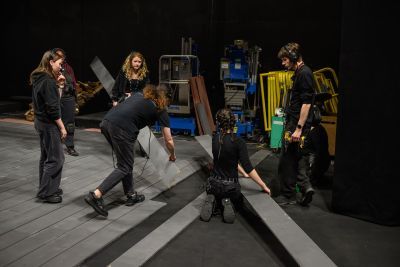
Summer – As Stage Manager I had several responsibilities in the rehearsal period. My key role is to write a daily rehearsal report that updates relevant departments on progress, staging, and any requests for new props or costumes. I also schedule the rehearsal call, organise wardrobe and WHAM (wigs, hair and makeup) fittings, and liaise with the production team.
The tech rehearsal period is busy, as I am responsible for driving the tech forward. Tech involves a lot of stopping and starting so departments can work on lighting states, sound cues, or quick changes. When the tech does stop, I check how much time departments need and relay this to the director and cast. I also liaise with the Deputy Stage Manager (DSM) to decide the best point to resume from.
Charlie – As an Assistant Stage Manager, my priority is knowing what is being run during that session and ensuring the stage is set with the correct props and furniture. We complete a cast sign-in to check everyone has arrived, and throughout the day we are present in technical rehearsals to cue on singers, reset the stage, and communicate any issues or challenges. Any gaps in the day are spent updating paperwork such as running lists or completing requests like altering props.
If you could work in any theatre or live event role, what would it be and why?
Summer - I would love to work in theatre as a Stage Manager or Company Manager. Both roles are very people orientated as they require a lot of communication with the cast, creative teams, and technical departments.
Charlie - I would love to one day be a Stage Manager of a big event or an unconventional theatre setting. Working with the same skills and budget to produce, for example, a corporate product launch would be exciting and challenging.
Finally, what are your top tips for applying to Guildhall?
Summer - My first top tip is to establish a clear understanding of the School and the course you are applying for. I would recommend reading the course outlines, attending an in-person or virtual open day, and watching a Guildhall production.
Having a clear passion and interest in your course is also super important for your application and interview. Whilst having experience is beneficial, Guildhall is a three-year training course, so you do not need to have loads of experience. They are looking for passionate individuals who have the drive and understanding of the School and the course you are applying for.
If you don't have a lot of experience, mention other things you do (e.g. volunteering, hobbies, team sport etc.), the skills you’ve gained and reflect on what it’s taught you – this can be used as demonstrating Stage Management qualities.
Charlie - Do not feel like you must know if Guildhall is right for you before your interview; it is just as much a chance for you to see if Guildhall suits the training you want to receive. However, putting passion into your application and interview is important; it is not as much about skill or experience but rather protentional to learn and successfully develop during the course. Be kind, ready, and enjoy it!